A common Chinese-style 144-tile set has 108 numbered tiles, 16 Winds, 12 Dragons, and 8 Flower or Season tiles. The NMJL-style American game taught here uses those 144 natural tiles plus 8 Jokers: 152 tiles total. Some Chinese variants omit the eight bonus tiles and use 136; there is no single tile count for every version.
108 + 16 + 12 + 8 + 8 = 152 tiles
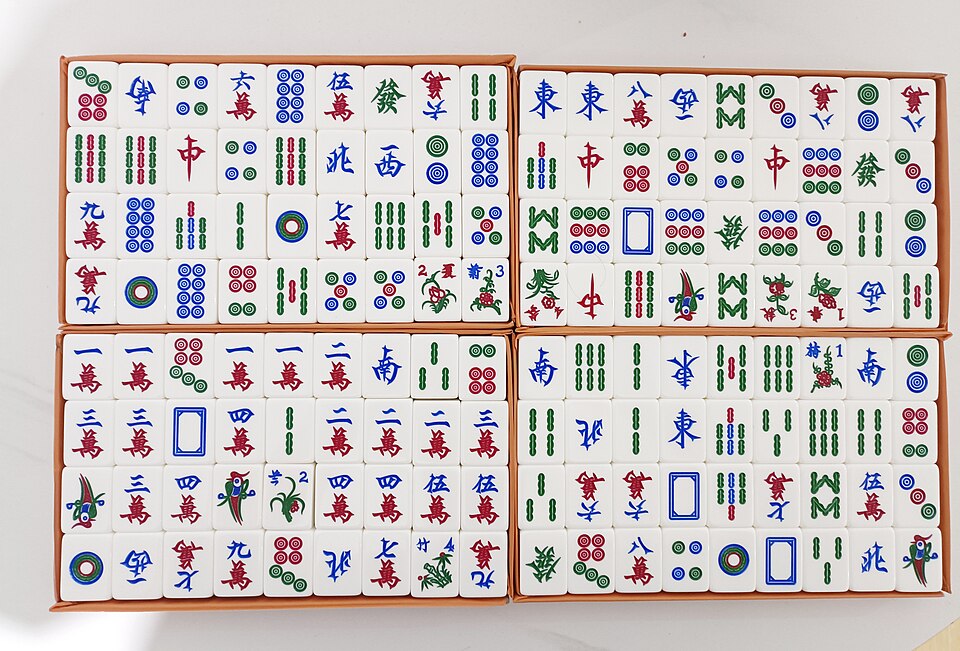
Craks · characters · 萬
One through nine; four identical copies of each number. The Chinese numeral sits above 萬. Some sets use the simplified 万.
 1 Crak× 4
 2 Crak× 4
 3 Crak× 4
 4 Crak× 4
 5 Crak× 4
 6 Crak× 4
 7 Crak× 4
 8 Crak× 4
 9 Crak× 4
Bams · bamboo · 條
One through nine; four copies of each number. The sourced reference design shows a bird for 1 Bam and distinct bamboo arrangements for 2–9. Sets vary, so match both the family and number.
 1 Bam× 4
 2 Bam× 4
 3 Bam× 4
 4 Bam× 4
 5 Bam× 4
 6 Bam× 4
 7 Bam× 4
 8 Bam× 4
 9 Bam× 4
Dots · circles · 筒
One through nine; four copies of each number. The circles form different arrangements for each number; their placement and orientation are part of the design. Compare the whole face, then count.
 1 Dot× 4
 2 Dot× 4
 3 Dot× 4
 4 Dot× 4
 5 Dot× 4
 6 Dot× 4
 7 Dot× 4
 8 Dot× 4
 9 Dot× 4
Four Winds · 風
East, South, West, and North; four copies of each. American sets may add E, S, W, and N in a corner.
 East · 東× 4
 South · 南× 4
 West · 西× 4
 North · 北× 4
Three Dragons · 三元
Red, Green, and White; four copies of each. Red commonly shows 中, Green 發 or 发, and White a blank or framed face. White is often called “Soap.”
 Red× 4
 Green× 4
 White / Soap× 4
Flowers and Seasons · 花牌
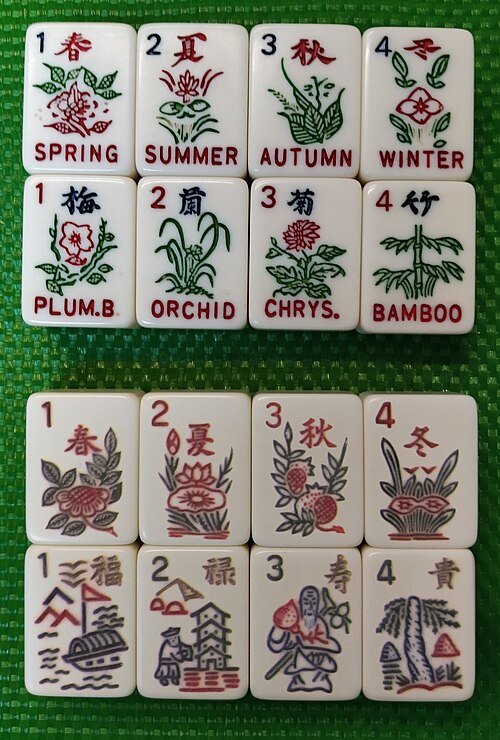
This photograph shows two actual American sets. The upper set has 春 Spring, 夏 Summer, 秋 Autumn, 冬 Winter, plus 梅 Plum, 蘭 Orchid, 菊 Chrysanthemum, and 竹 Bamboo. The lower set uses 福祿壽貴 instead of the four named plants. American play counts either design as eight Flowers. Printed flower numbers do not matter. Do not automatically set Flowers aside for a replacement draw as in some Chinese rules.
Jokers · American addition
Eight Jokers complete the 152-tile set. They can replace tiles in certain groups of three or more identical tiles, but not Singles or Pairs. Read the Joker limits →
 Joker× 8
Try this with a real set.
Pick a tile. Name its family, number or direction, then check how many copies are in the box. Extra blank or spare tiles supplied by a manufacturer are not part of this 152-tile game.